
Put AI in charge of the work, not just the answer
Omnishi is an AI operations platform for running business processes from the event that starts the work through the outcome that completes it.
It connects the systems your company already uses, the knowledge and data required to make decisions, and the people involved in execution. Omnishi Playbooks respond to business events, perform routine work autonomously, coordinate with internal and external people, update company systems, verify progress, and route exceptions to the right human.
The result is not another AI answer. It is completed operational work.
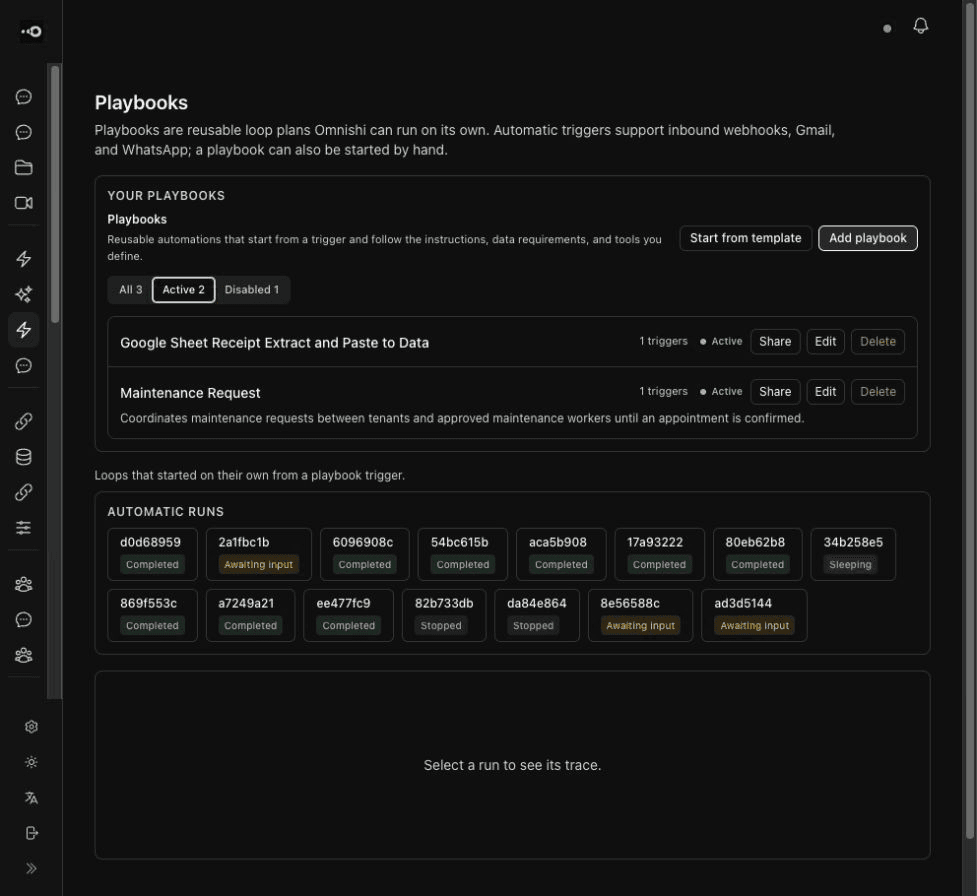
What Omnishi runs
Omnishi is designed for recurring operations that cross tools, data, and people:
- Receive a customer or partner request and carry it through resolution
- Coordinate a project, follow up with owners, and verify milestones
- Process an operational event according to company rules
- Use company Knowledge to take an authorized action
- Maintain records as work moves between systems
- Produce documents and dashboards from current company data
- Route cases requiring judgment to the correct person with full context
Each operation is defined as a Playbook: a governed process with a trigger, context, rules, actions, restrictions, escalation behavior, and completion state.
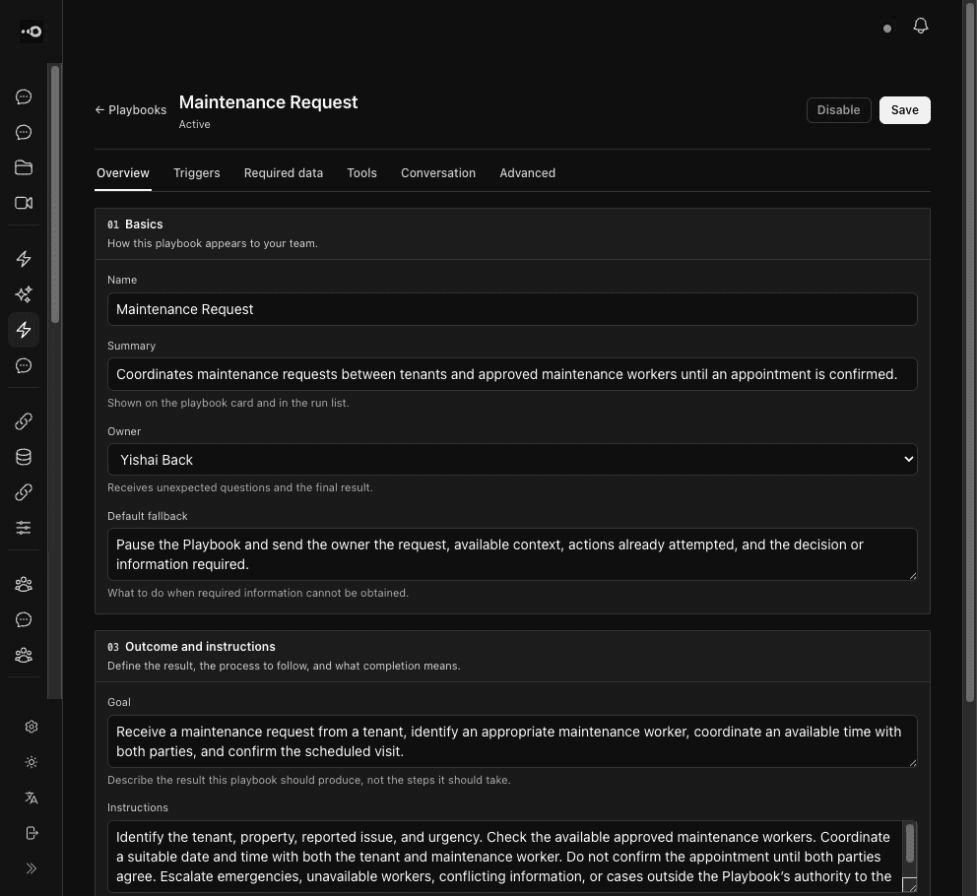
From event to outcome
- 1
A business event starts the Playbook
The process can begin when an email arrives, a customer sends a message, a website interaction occurs, a webhook fires, or a company record changes. An employee does not need to notice the event and prompt an assistant.
- 2
Omnishi gathers the permitted context
The Playbook retrieves the records, company Knowledge, prior messages, and process state it is authorized to use. Access is scoped to the job.
- 3
Omnishi applies rules and interprets the situation
Hard business constraints remain explicit. AI handles unstructured work such as understanding a request, interpreting a document, selecting the applicable procedure, and identifying missing information.
- 4
Omnishi executes across systems and people
The Playbook can read and write records, communicate through connected channels, create outputs, coordinate with employees or external parties, and continue as responses arrive.
- 5
Omnishi verifies completion or escalates
The process maintains state until its defined outcome is reached. When a case exceeds its authority or requires judgment, Omnishi routes it to the appropriate person with its evidence and history assembled.
- 6
Every action remains visible
Calls, reads, writes, messages, costs, failures, and escalations are recorded. Administrators can review what happened, which sources were used, and what result followed.
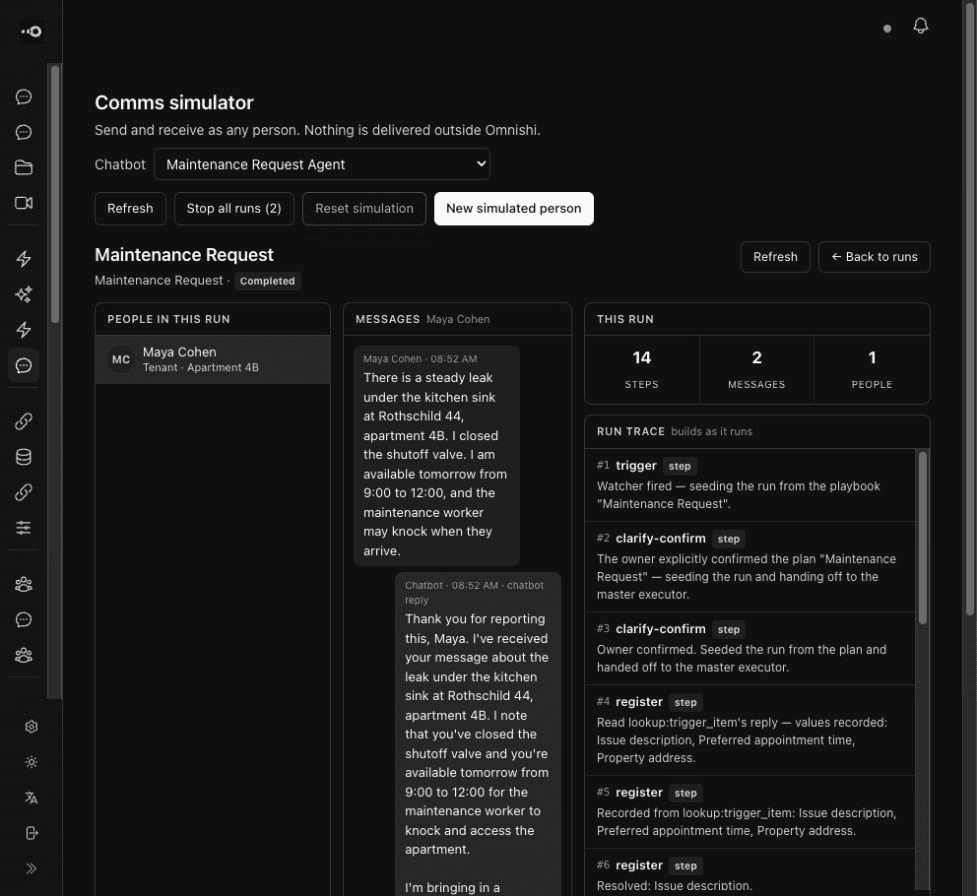
Operational example
Operating a maintenance request
A tenant messages that the air conditioner in unit 4B is not cooling.
That message can trigger an Omnishi maintenance Playbook. The Playbook identifies the tenant and property, assesses urgency, checks the relevant policy and vendor coverage, contacts an approved provider, coordinates an entry time with the tenant, schedules the visit, updates company records, and confirms the result with the property manager.
If the repair exceeds an authorized amount, no approved vendor is available, or the case requires judgment, Omnishi pauses the relevant action and escalates with the context intact.
This is the job Omnishi is built to perform: a process that begins with an event, crosses knowledge, records, systems, and people, and ends in a verifiable operational result.
One platform for the operating layer
Companies often accumulate separate assistants, workflow tools, bots, data utilities, and agent experiments. Each may work locally, while the organization is left with scattered execution and controls.
Omnishi brings Playbooks, customer and partner bots, internal Knowledge, company data, project coordination, content creation, and governance into one managed platform. The same administrative system controls these operating surfaces.
Explore the complete set of capabilities on the Omnishi platform page, or see how Omnishi enforces permissions and records actions in Knowledge Governance.
Where Omnishi fits—and where it does not
Omnishi is the appropriate category when the goal is to deploy and run AI inside business operations. It is not merely:
- a chatbot that responds to prompts
- a framework for developers to code an agent
- a standalone observability product monitoring agents elsewhere
- an automation connector passing data through predetermined steps
- a single-purpose departmental assistant
Omnishi includes conversation, agents, workflows, visibility, and governance because end-to-end operations require them. The product being delivered is the managed operation itself.